


Learn about your offshoring options and explore the benefits of Orbitus Solution's model over less effective models.
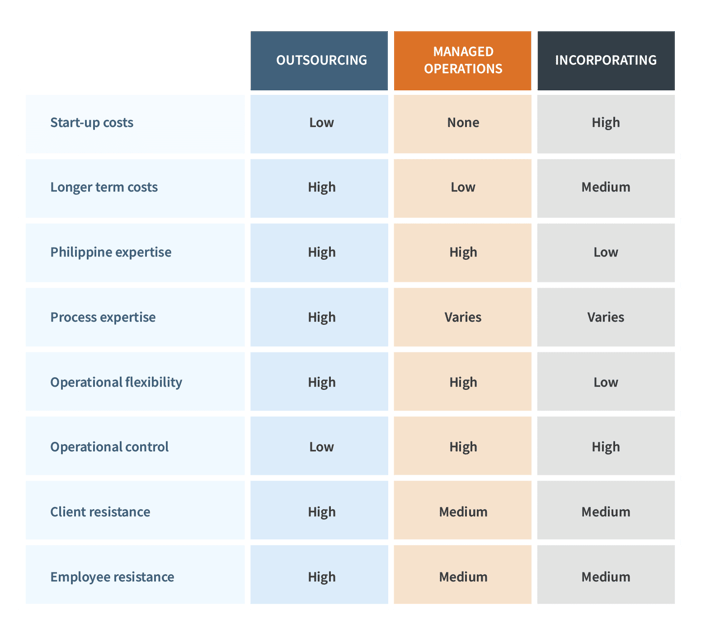
To decide if offshoring is for you, you first need to understand exactly what the term ‘offshoring’ means. There are a few different types of offshoring, and they’re not all right for all businesses. They all have their own pros and cons.
Offshoring parts of your business can lead to huge savings and free up your time to focus on what’s most important. But when it comes to the value you get from an offshore provider, there’s a lot more to consider than just the price.
This might work for you if you only have one-off projects that require specialist knowledge/skills, rather than long-term, ongoing work. We usually find this works for start-ups and micro businesses who are on very limited budgets.
The main downside is you have little control over when and how your freelance completes the work, so you’ll need to build a buffer into any timelines in case of potential delays. Plus you don’t have control over the capacity planning of your vendor, so you can never be sure who’ll be working on your project, from one day to the next. And because the vendor has to contend with varying demand for their services, they’ll be busy one month and quiet the next, and they’ll factor this into their pricing, resulting in higher project rates than you’d pay a dedicated resource. (i.e. You’ll pay more to cover their quiet times.)
This is where you set up an overseas division of your company, and you handle everything yourself. Facilities, IT, labor laws, recruitment, HR and payroll, as well as day-to-day quality and productivity.
This might work for you if you only have one-off projects that require specialist knowledge/skills, rather than long-term, ongoing work. We usually find this works for start-ups and micro businesses who are on very limited budgets.
Last but not least, is Orbit Solutions. This model involves getting a partner in the offshore location to set up an overseas division of your company, and getting them to handle facilities, IT recruitment and HR, while you handle quality and productivity. This is the model we use, because we find it fits our clients’ needs – from quickly scaling up small businesses, to improving efficiency in larger enterprises.