Outsource Creative Services
You may outsource creative services and assemble the ideal team to complete tasks more quickly while working only for your business. This includes marketing, content writing, design, and animation.
While being ambiguous, the term "creative services" is intriguing and conjures up visions of stylishly crafted viral marketing efforts.
The truth may sometimes be far more boring and time-consuming, not to mention confusing and expensive, especially when you most need the marketing momentum to advance your company.
Moreover, creative roles cannot be discounted as mere decorations. In today's market, brand identification is essential. Every year, billions are spent on adjusting campaign specifics to get in front of the appropriate audiences, in the right situations, and then evaluating the results. The term "omni-marketing," which refers to campaigns with an integration approach to touchpoints across all channels, is becoming more and more popular in the marketing industry. This creates a "seamless" consumer experience. That's a big ask for the irregular half-hour breaks in between sessions.
Two-thirds of the organizations polled last year had already started or were expecting to start a digital marketing transformation within the year, according to research by marketing analyst company Smart Insights1. It requires knowledge, especially in light of marketing trends that are rushing to adopt cutting-edge strategies like voice marketing and AI. Of course, it also costs money.
Book a Free Consultant
Data from Glassdoor.com shows that creative services managers in the United States earned an average base salary of $63,723 in 2019, with some companies paying over $150,000 in creative services. Digital marketing specialists earned an average salary of $60,714. There was a wide range of advertising copywriter salaries in Australia, from $78,000 to well over $100,000 Australian dollars. Even before paying for site costs and software upgrades, assembling even a small team of competent local creatives would soon stretch your budget.
What are your Alternatives?
In the past, businesses had three major options to having a wholly internal creative services department: hiring freelancers, outsourcing creative services to a nearby creative firm, or combining a smaller internal workforce with outside agencies or freelancers.
There are many benefits and cons to each of these choices.
Agency
Choosing a full-service professional agency can seem like the choice that would give you the greatest peace of mind, but it can also be the most expensive. Also, businesses of this type frequently put a lot of effort into developing their unique characteristic look. You are paying them for their expert judgement, so if giving up control of your own creative vision makes you uncomfortable, this may not be the best course of action.
In most cases, a contract with a creative firm will also include extra costs for any unanticipated changes to the initial work completed, as well as new contracts for revised campaign elements. Under the fundamental quotation, the agency may even retain the copyright of the concepts. The best course of action may not be to outsource creative services to an agency if you believe it is probable that these problems would hinder your company's growth.
Freelancers
A tiny band of freelancers can be a nice middle alternative for developing businesses, offering the flexibility of up-front fees, without any obligations.
The juggling, though, might end up being more work than it's worth as your creative requirements become more complex. Can you allocate enough administrative staff to manage the many contracts and make sure you're getting a reasonable price? In addition, without the unifying vision of an experienced creative manager, you risk producing a patchwork, subpar final result.
Mix and Match?
If you maintain more control while benefiting from targeted professional guidance and extra freelance talent and support from a creative agency, then a skeleton team bolstered by freelancers or supported by one is a good compromise. But is it truly more affordable than keeping everything in-house for the business? Having to keep track of many contracts and tariffs will take up some administrative time. And what if you require a strong, coordinated effort to promote rebranding or a significant product launch, and the agreement falls apart? Your long-term goals shouldn't include that type of brand identity risk.
Offshore Option
If you maintain more control while benefiting from targeted professional guidance and extra freelance talent and support from a creative agency, then a skeleton team bolstered by freelancers or supported by one is a good compromise. But is it truly more affordable than keeping everything in-house for the business? Having to keep track of many contracts and tariffs will take up some administrative time. And what if you require a strong, coordinated effort to promote rebranding or a significant product launch, and the agreement falls apart? Your long-term goals shouldn't include that type of brand identity risk.
Not only does this drastically reduce expenses, it also enables you to keep control and ownership of your creative processes and resources. And you can have faith in a cohesive group of knowledgeable branding, digital, and design specialists who will work in harmony with your creative leaders and stay loyal to your vision.
Moreover, this kind of offshore has given rise to an altogether new business. It is known as creative process outsourcing (CPO), and it developed from the classic business process outsourcing (BPO). Established offshore providers may assist you in assembling a tailored and reasonably priced creative team of seasoned specialists.
You can find creatives with the necessary assistance who have a track record of developing successful campaigns similar to what your business requires, who may also have experience working collaboratively, and a creative manager to quickly and effectively communicate your design and branding needs to the team.
Your customer involvement will then soar tremendously as a result of improved social media, advertising, and online communications, and you'll need to dedicate all of your domestic staff's time to sales and development simply to keep up with the demand.
Typical Creative Services Tasks That are Outsourced
Occasionally, it might be difficult for a busy non-creative to understand what responsibilities belong into the category, where branding and marketing begin, and how much of the work ultimately involves Technology. The range of creative outsourcing solutions includes all marketing and advertising procedures and activities, as well as the technical, artistic, and managerial jobs that support them.
Among the support roles in creative services, these are some of the most often outsourced positions. In these positions, employees implement the branding and marketing plans developed by creative leaders. They develop the artwork in accordance with guidelines and create the content for all platforms, directing people back to your website and boosting sales. They design the web presence's aesthetic and user interface, as well as any flash or animation "bells and whistles" that can grab the unreliable attention of the general public. Once the brand image is formed, these talented team members also keep up with and update marketing materials.
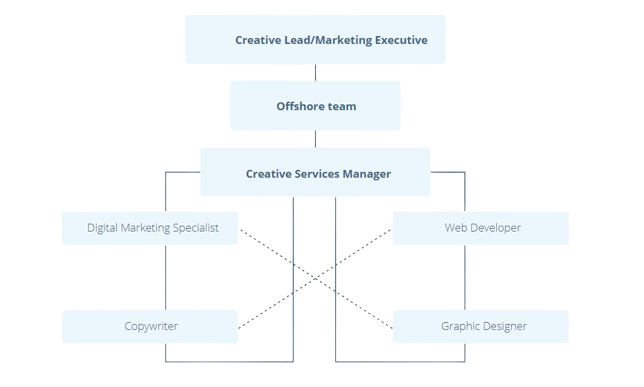
A modest, beginning team providing outsourced creative design services usually consists of the following individuals:
- Creative Manage
- Web Developer
- Copywriter.
- Graphic Artist
- Digital Marketing Specialist